Millisecond pulsar X-rays

Neutron stars are so tiny and so dense that the natural temperature scale for them has them glowing in the X-rays. What's more, they serve as powerful accelerators of electrons, which then naturally produce X-rays. So it turns out that X-ray telescopes provide a very interesting view of pulsars. In light of this, when we discovered my pet source, J1023, we took an X-ray observation of it. It's taken us considerable time to analyze the results and put together a paper describing them, but I think the result will be a valuable contribution to the literature. (More importantly for me, it should make a chapter of my PhD thesis.) The result is the cumbersomely-named "X-ray Variability and Evidence for Pulsations from the Unique Radio Pulsar/X-ray Binary Transition Object FIRST J102347.6+003841".

Much of the paper is devoted to details of data analysis, which I will spare you. But I think the gist is interesting, and not too hard to summarize. 

Full post

Ignition!

Recently, via Derek Lowe's In The Pipeline, I came across the book Ignition!, by John D. Clark. It's the story of the development of liquid rocket fuels, told by a man who was head of one of the programs. Even if you don't know much chemistry — I don't — the book makes a fascinating read. The image on the left is the first page you see when you open the book, and the image below is the second.


Full post

Ergo Proxy


As is obvious to regular readers of this blog, I read a lot of science fiction. I also enjoy science fiction movies and TV shows, but they're generally much harder to find. Or at least, ones I like are. But I came across an enjoyable new series recently: Ergo Proxy. It's a cyberpunk anime with a female protagonist that I came to rather like in spite of her cold and sometimes difficult personality. The series is obviously some sort of cousin to Ghost in the Shell (albeit without some of Shirow's particular obsessions) and Serial Experiments Lain (though thankfully free of schoolgirls). On the Western side, I suppose I'd compare it to The Matrix (or maybe the similar-but-better The Thirteenth Floor) and The Prisoner

As those analogies suggest, the series is sometimes a little heavy on the symbolism, mystery, and spouting of philosophy, but that's all part of the cyberpunk tradition, and this series carries it off well. I enjoy the visual style as well, though there are a few moments where the animation is a little off. The soundtrack is the kind of music I listen to anyway, which helps. I usually prefer subtitles to dubbed audio, but for this show the dub is better written and well-acted. All together a fun experience. 


[Edit: you can watch the whole thing online.]

Full post

Reporting FAIL

There's currently an item in the news about a British boy who managed to damage his eyesight with a "laser pointer". The news articles generally imply that any laser pointer is a lurking risk to your eyesight ready to blind you with a single incautious glance. But there are the ordinary 1-5 mW laser pointers you can buy in dollar stores, and then there are the pocket lasers you can buy online that have powers up to 500 mW and that can burn a hole in a credit card. If this kid managed to damage his eye with the former, well, that's surprising and alarming. But the articles don't describe the laser at all, beyond the fact that he ordered it on the internet. If you go to the original one in the British Medical Journal, though, you still don't get the power rating, but you find out that it was "high-powered", i.e. almost certainly one of the high-power ones you can get online. Of course you can damage your eyes with these; I strongly doubt it would be possible to get one without being made aware of the danger. What's more, the high-power ones are already arguably illegal in many places, not that that stops online companies from shipping them there.

The key point I'm getting at is that all the media coverage is missing the essential information that this is not a normal laser pointer, and that those are basically not dangerous.

[Edit: I emailed the corresponding author of the BMJ piece. Unfortunately the boy's guardian destroyed the laser before the doctor could see it, but the doctor is certain that it was one of the high-powered lasers I describe above. It's too bad none of the reporters bothered to check that detail, but I guess it doesn't make good copy.]

Full post

Virtual idol

Years ago, I'm not sure when or where, I saw the anime Macross Plus, which is about a pop star who is entirely a computer program that sings, but who has fans as devoted as any present-day pop star. Anime being anime, there was of course a whole plot line about her AI going rogue (plus giant robots of course), but I remember thinking "how weird, a pop star who doesn't exactly exist". Well, technology progresses, and sure enough, we have one now.


Full post

Laser rifles

Laser rifles have been a staple of science fiction for years, though now that cheap harmless (or nearly) lasers are everywhere writers are moving to other buzzwords. But I had no idea that anyone had come up with a more-or-less workable design until I stumbled across the "Stavatti SF-1" and "TIS-1".

(More below the jump.)

Full post

CASCA 2010 compact objects session 1

Orbital eccentricity in numerical simulations of binary black holes (Harald P. Pfeiffer)


Eccentricity in black-hole binaries is radiated away faster than the semi-major axis, so that they become circular fairly rapidly. Thus, for example, when a binary makes its way into the LIGO band the eccentricity is down around 10^-6. For numerical GR this means you have to be able to measure - for that matter, define - eccentricity, and you need to be able to produce near-zero eccentricities. To define it, you often construct some function that measures deviation from a circular inspiral, but this is difficult because of (among other things) coordinate dependence. It turns out it works better to define eccentricity in terms of its  gravitational wave effects. You also have to work on periastron advance (for which third-order post-Newtonian models are not good enough). How is very low eccentricity achieved? The problem is in constructing your initial data: coordinate location, sizes, velocities; these need to satisfy complicated PDEs to satisfy the constraints, and it's not clear what goal values you should choose to get circular orbits. The approach is to simulate a few orbits, then fix the initial condition as if it were Newtonian; this roughly works, so you iterate the process until you get a nice low eccentricity. When you go to precessing binaries (i.e. rotating black holes) spin-orbit coupling complicates your life, but you can still extract an eccentricity measurement and initial condition corrections.

Rayachaudhuri's Equation in Regge Calculus (Parandis Khavari)


These equations are important in the proof of singularity theorems, lensing, collapse, and cracking under self-gravity. They concern expansion and shear of fluids in self-gravitation. Absent vorticity they imply collapse into a singularity in a finite amount of time. Regge calculus is finite-element GR that fixes flat geometry within simplices; curvature is concentrated on n-2-dimensional sub-simplices ("bones") and can be described by the deficit angle. Geodesics in the Regge calculus are straight lines within simplices; where they meet faces, the angle on the entrance edge matches the angle on the exit edge, but it's a little tricky since there's no unique way to assign the deficit angle to the n-1 simplices around a particular bone. This work is about expansion of geodesics in (2+1)-dimensions. She obtains expressions for shear and expansion of lensing. Remaining problems include that Rayachaudhuri's equation has no unique discrete representation.

Numerical simulations of precessing binary black holes (Abdul Mroue)


Gravitational wave detection will only be possible if we have accurate banks of template gravitational waveforms. The three main categories are inspiral, merger, and ringdown. To build these templates we need some combination of post-Newtonian models and numerical relativity. We expect an event in the LIGO range at a rate <1/year, but advanced LIGO should have ~0.5/day. So building a template bank is crucial. The parameter space (for zero eccentricity) is given by the mass ratio and the two spins. A 15-orbit binary takes ~10^5 CPU-hours (plus a great number of grad student-hours). Less than 100 waveforms are available from all groups worldwide. So far very little work has been done on systems with generic spins. The spin has very significant effects on the system evolution. This work has two major approaches: make BBH runs easier (i.e. reduce the person-hours) by automating the initial setup and transition between regimes, and make BBH runs faster, primarily by making their simulation code run on GPU supercomputers (possibly an order of magnitude speedup). Currently running on his desktop's GPU.

Questions: Do we expect spin-orbit alignment? Maybe; what happens in the final orbits is totally unclear. [No comment on whether binary evolution is likely to produce aligned binary systems.]

Modelling Gravitational Lens Systems with Genetic Algorithms and Particle Swarm Methods (Adam Rogers)


Lensing has been observed on many cosmological structures; it's interesting because on the one hand it depends on the mass of the lens, and on the other hand it provides an important magnification effect. The goal of this research is to try to reconstruct the un-lensed image of the source. They assume a thin lens. The lensing equation is clearly nonlinear, as shown by multiple lensing. Rather than solve a complicated nonlinear equation, one can simply raytrace past a lens shape. One can combine this information into a mapping matrix; in this formalism, finding the source pixel intensities is a linear least-squares problem. Unfortunately the matrix sizes are comparable to the number of pixels [so you need sparsity], so you need to use a small PSF, i.e. optical data. With some cleverness one can reformulate the problem into a deconvolution problem that never needs to construct the huge matrices. On simulated data it's quite effective at recovering even highly distorted images when you know the lens parameters. Finding the lens parameters requires a fitting procedure, for which he's using genetic algorithms and particle swarms. Particle swarm optimizers attract each particle to its local best and the global best according to a spring force. Of the two the particle swarm optimizer is a little faster, while the GA is much more thorough in searching the parameter space (e.g. local loses one of the two 180-degree options for ellipse orientation).

Questions: Have you applied your models to real data? Yes, but it's old data that's already been partially processed. What is he optimizing? "chi-squared between the model and the data"

New properties od teh 35-day cycle of Hercules X-1 (Denis Leahy)


RXTE ASM data of Her X-1, plus PCA data when available. Her X-1 is 6.6 kpc and high galactic latitude; it's a neutron star with a 2.5 Msun A7 companion. Over 35 days (many binary orbits) you get brightness variations. One model is a twisted disk that occults the NS; its shadow on the companion star changes on the same cycle, which explains the optical variations. ASM data shows that the cycle length varies substantially - 34-38 days - and this variation is correlated with the flux. The turn-on appears to occur uniformly in orbital phase. They have 1.58 Ms of PCA data in total. One idea for explaining some of the irregularities is that the impact point on the disk is not the outer edge, since it's not flat; other models include an uneven disk surface or blobs in the accretion stream, but these don't match the data well.

Questions: Why is the disk twisted? Heating by the central source  produces a torque that increases as the disk gets out-of-plane up to the point where it starts shadowing itself.

Full post

CASCA 2010: Stars 3 session

Variable stars in the Hyades Cluster (Jayme Derrah)

To establish distance scales you need to measure variable stars at known distances; the Hyades cluster is the closest open cluster to the Earth. Unfortunately it's just out of range for accurate parallax measurements, so distances are measured using the "convergent point method". Variable stars of interest re eclipsing binaries and pulsational variables (though few new examples of the latter are expected). The project uses the Baker-Nunn patrol camera, which has a large enough field of view to include the whole cluster and reaches a limiting magnitude of 19.5 in two minutes; on the other hand there's only one filter, a light pollution blocker. Follow-up of discovered variables will use B and V.

Type 1A Supernova Progenitor Diversity (Ashley J. Ruiter)

Sub-Chandrasekhar-mass WDs should be looked at as SN1A progenitors. SN1A light curves are driven by the amount of nickel produced, so we can use them as standard candles almost without any idea of what the progenitors look like. Theories are CO WD mergers and CO WD collapse triggered by companion Roche lobe overflow. Simulations predict that the former ought to produce NSes instead, while models (including this work) have difficulty producing enough of the latter. In particular, she built a population synthesis code and found an order of magnitude too few overflow models. The idea is that perhaps allowing sub-Chandrasekhar-mass collapse can help. More detailed models, in particular using helium accretion, allow collapse to occur with 0.8-0.9 Msun: you get detonation in a shell of accreted helium which triggers the explosion. She built simulated light curves based on such explosions and found reasonable agreement with observed light curves [but how hard is this, if nickel mass is all you see?]. From a population synthesis point of view, though, they do provide enough. It's also theoretically nice because it explains the observed variety in light curves: it's a function of mass at collapse.

Questions: Where do these helium-rich companions come from? Many are He white dwarfs, which arise naturally in such binaries (lost their hydrogen through Roche lobe overflow). What's that blue line on the graph? It turns out if you start with 0.9 Msun WDs the merger scenario looks a little more plausible. What assumptions go into the pop. synth? Standard IMF, etc. Where does the mass go during binary evolution? Eddington-limited transfer, so probably outflows.

Tau Sco: The Discovery of the Clones (Veronique Petit)

Part of the MiMeS (Magnetic Field in Massive Star) collaboration. There ~35 known magnetic OB stars (i.e. B directly detected, which is hard), but it has long been suspected that B is ubiquitous in massive stars. ("Magnetic fields are to astrophysics as sex is to psychology." - someone) These stars are short-lived but important, and the key complicating parameters are rotation and mass loss; we expect B to substantially affect the wind (as it does in the Sun). Tau Sco, a B 0.5 V star, is the focus of this talk. We can measure B by the Zeeman effect, i.e. circular polarization across a spectral line. If you sample the stellar rotation, you can actually produce B maps. Unlike all other massive magnetic stars which have roughly dipolar fields, tau Sco's field is complex and multipolar. Studies of the wind using UV line profiles show strange inconsistencies between different line traces; there seems to be some correlation between the UV variability as a function of stellar rotation and the B. It's natural to assume that the wind anomalies arise from the complexity of B, but it was hard to test until their recent discovery of two "clones" that have similar wind anomalies and slow rotation. ESPADON shows that these stars are magnetic; sadly it has not yet been possible to sample the stellar rotation densely enough to map the magnetic field. Preliminarily, though, a dipole model suggests that surface B is roughly equal to that of tau Sco. 

Questions: Have people measured this supposed correlation between B and the wind? Yes, but it doesn't really predict tau Sco. How strong are these Bs? ~500 G. Does B of tau Sco vary with time, particularly in flares? We don't know, they had to assume it depended only on rotation. Could you use the Bayesian inference to estimate non-dipolar fields? There's too much uncertainty when you don't know about the stellar rotation.

Tracing Wolf-Rayet wind structures (Alexandre David-Uraz)

This work focuses on WR113. WR stars have very high mass loss rates, high enough that radiation pressure alone can't explain it; we need to understand the physics of clumping. WR113 = CV Ser is a binary system in which the companion can often be seen through the WR wind. It's a double-line binary, so they can in principle get a decent picture of the orbit, but so far the spectrum has been too messy. Once this is accomplished, they should be able to separate the two spectra quite well - average everything in the WR frame, then subtract this and switch to the companion's frame, then back and forth. In any case, the "eclipse" is of depth ~0.6 mag - well, in Lamontagne et al. from the 90s; in a 1963 paper the eclipse seems variable (0.1 mag sometimes and 0.6 mag), and in 1970 they didn't see an eclipse at all. MOST sees a shallow eclipse but variable - in fact, two successive eclipses differ very substantially. The real focus of the research is random variations due to clumping, and indeed they see both photometric and spectroscopic evidence for clumping. There's also the issue of a colliding-wind shock, which shows up in the lines (in particular there's streaming along the shock); with luck this should help establish system geometry. The next step is Fourier analysis for pulsations in star or wind, and wavelet analysis for random clumping. The goal is to link these to spectroscopic data and constrain the clumping.  

Questions: This is a complicated system; is there evidence for an accretion disk? Unclear, but the colliding winds suggest not. Is this the only eclipsing WR star? No, there are others. 

Limb-Darkening and Stellar Atmospheres (Hilding Neilson)

Limb darkening is particularly interesting these days as observations become more constraining. They affect planet parameters inferred from transits (and fitting can constrain limb darkening). Optical interferometry can directly measure it, and microlensing can help as well. Limb darkening tells you something about conditions in stellar atmospheres; Schwarzschild used solar eclipse observations to show that the solar atmosphere is in radiative rather than adiabatic equilibrium. Traditionally, though, people just use empirical limb darkening laws that are pretty crummy; in fact popular parameterizations have fixed points that are more or less independent of the parameters, and fit observations rather badly. The fixed point arises because the models the empirical laws are based on all make the Eddington approximation. Spherical symmetry rather than plane-parallel atmospheres helps spread the fixed point out. Detailed modelling suggests that the true value at the fixed point probes atmosphere physics. Observations suggest that you can make these inference even with the wrong models.

Full post

CASCA 2010: planets session

NIR from hot Jupiters (Bryce Croll):

Hot Jupiters are tidally locked, and one expects their properties to depend on the amount of heating. He tested this with four known hot Jupiters. To get good photometry, he used WIRCAM out-of-focus (!). This lets them detect the thermal emission from hot Jupiters (millimagnitudes). "Hot" and "hotter" distribute heat very effectively, though "hotter" shows abnormally low H-band emission; maybe an absorber? "Even hotter", on the other hand, doesn't distribute heat very effectively. "Hottest" shows redistribution within the hot side but not between sides, plus evidence for a thermal emission deep in the atmosphere.  Many more CFHT observations are planned.

Music of the Spheres: Results from the Kepler Mission (Jason Rowe):


Kepler's a 1m space telescope designed for steady monitoring of a fixed field of 100000 stars, looking for exoplanets and asteroseismology. CCDs were placed so that the brightest stars fall into the gaps. Kepler's bandpass is more or less white light (400-900 nm). Measurements as good as one part per million for  many stars; Kepler's working very well. The parameters you fit directly include stellar density. The smallest planet so far is ~Neptune-sized, but some secondary transit measurements show you could detect a terrestrial transit. In asteroseismology they should get p-modes for every star brighter than ~12 mag. Also some weirdos like helium white dwarf companions, for which radial velocity followup has begun. Apparently Kepler also has Guest Observers and Target of Opportunity arrangements.   Quite what this means I'm not sure, since the instrument isn't pointed.

In questions, they do have lots of earthlike transit candidates - but they get lots of false positives from photometry alone, let alone grazing transits by bigger objects.

SPI or Spin-up? An UV Investigation of Activity on Exoplanet Host Stars (Evgenya L Shkolnik)

"SPI" is "star-planet interaction", meaning magnetic. Spin-up is tidal effects of the planet on their stars. These should occur since the planets are so close to their stars. Both should show up as increased stellar activity (hence the UV). Looking at X-ray data, there's debate about whether this is observed. She used GALEX (175-275 nm). GALEX sees almost every exoplanet host star (that's in its field of view). Given 135 GALEX detections, start with close-in planets seem to be ~2x brighter. (Planet distance is a bimodal distribution, so there's a natural dividing line here; we think it's migrated versus not migrated.) A few transiting systems have been observed to have abnormally rapidly rotating stars; if this is a general phenomenon, gyrochronology goes out the window. The exceptions, stars that aren't active in spite of close-in planets may be explicable in terms of some scattering models but not others, and in fact the exceptions are more eccentric, consistent with the potentially recent scattering models.

Super-Earth Transit Search with the MOST Space Telescope (Diana Dragomir)


Start with radial velocity candidates from HARPS; F, G, K with 2-20 Mearth planets. MOST watches during the transit window. Key transit parameters are period, phase, duration, and depth. Diana's idea is to use Bayesian methods to fit the model, which is feasible mostly because the HARPS candidates provide a drastically reduced parameter space. (Ew! She uses JDs!) This parameter space needs to be very finely sampled to avoid underestimating the depth. (She's using grid sampling rather than MCMC because of the small low-dimensional parameter space.)

Ultra-Wide Trans-Neptunian Binaries (Alex H. Parker)

You classify TNOs based on their resonance with Neptune: the plutinos, for example are roughly 3:2 times the period. The big question is how the TNOs got there, since they haven't had time to form in situ. One answer is that as the giant planets moved out to their current positions they scattered the planetoids out into the outer solar system. This talk is about binaries; binaries are present throughout the solar system. Binary asteroids are different, as they tend to have large mass ratios and tight circular orbits, suggesting a collisional origin. The TNOs have lots of binaries, with a wide range of eccentricities and often modest mass ratios. These binaries are interesting observationally because you get mass measurements. Wide binaries are resolved with Gemini, and they're so delicate you can test dynamical ideas with them. Their formation mechanism is debated, maybe three-body exchanges, maybe temporary capture into chaotic orbits, but the mutual orbit distribution should allow them to be distinguished. His sample is >0.5'' apart and mags differing by <1.5. Typicallt separations ~1'' and mags ~24. Terrestrial parallax allows measurement of things like the direction of the orbital axis. The observed distribution doesn't really fit with either formation model. You can also use these to look at the number of ~1km objects in the Kuiper belt, since these objects will eventually break up such a system. These small objects  can't be made through accretion or collision, they have to be primordial.

HST Compositional Survey of Faint Kuiper Belt Objects (Wesley C. Fraser)


The idea is to look at chemical gradients in the protoplanetary disk; this is closely related to understanding their scattering history, which is what dominates their current dynamics. Compositionally, only the biggest can retain methane (as it evaporates on a timescale of thousands of years). The fainter ones you don't get much in the way of lines, so the data is mostly colour (some are neutral, some are quite red). In the IR you do see deep water ice on certain objects ("family members" in resonances?) but not on others. It's a little puzzling what these objects are actually made of. Fortunately WFPC-3 is almost ideal for this work, with filters for water ice, methane, and a couple of useful narrow-line filters. The colors show evidence of a mix of water ice and some red gunk in varying proportions. Centaurs, objects that have been scattered further into the solar system show evidence for solar processing. Other objects are more mysterious.

Searching for Main-Belt Comets Using the CFHT: Final Results (Alyssa Gilbert)


Main-belt comets reside in the asteroid belt but show cometary activity. Their origin is unknown; formed in situ, which would be weird, since we don't expect ice within the orbit of Jupiter, or maybe formed further out and somehow got stuck in the asteroid belt. Only five objects are known, and have been recently found. Small bodies are interesting because they form in different parts of the solar system, and they don't have sesimology or weather, so they provide fairly direct pictures of the structure of the early solar system. To find these objects, she used the CFHT legacy survey data. The cadence is 3 observations in one night followed by another a night later (weather permitting). Automated object selection not terribly effective; visual inspection of 25000 objects worked better and found one. (Somebody has a very high tolerance for boredom...) Unfortunately the object wasn't noticed until a year after the observations, so even though a rough orbit was found the object was lost.  Asteroids activated by collision might produce an appropriate number, but the activity of some of these objects seems to be periodic, which is weird. Capture from the outer solar system should provide too many.

Full post

Light echoes

Occasionally some astronomical event — a gamma-ray burst, a supernova, a magnetar flare, or whatever — will go off, lighting up the sky more or less spectacularly and then fading. Normally that's the end of that event, and we're left to wait for the next one. (In particular, this means that if you study this sort of thing, you need to be prepared for one of these things to happen at any time, so that you suddenly need to write target-of-opportunity proposals, analyze data, and release preliminary results in a tearing hurry. This typically happens while you're supposed to be on vacation.) Once in a while, though, we see a peculiar phenomenon called "light echoes".

A "light echo" arises a little like an ordinary (sound) echo: some event happens producing a bright flash (loud noise) and in addition to the light (sound) making its way to you directly, some of the light (sound) goes in a different direction, bounces off something, and makes its way from the other object to you, arriving a little later. From the place I usually stand to watch the summer fireworks competition, you hear the big skyrockets go off, then a second or two later you hear the echo from a nearby building. Of course, on human time and distance scales, the light from the fireworks reaches us instantaneously, so it's obvious that both the original sound and its echo are delayed. In an astronomical setting, we only receive light, and it takes very much longer. But it's still possible to receive a delayed echo, and studying these echoes can be very informative.

(Photo, courtesy of ESA, to the right is X-ray dust echoes around the magnetar 1E 1547.0-5408, one of the objects people in the group here at McGill study. This interesting dust-echo work is from another group, though. The echoes are from a massive X-ray outburst, which we think was caused when the extremely strong internal magnetic field stresses cracked and twisted a piece of its crust; this twisted the external magnetic field, and the twisted magnetic field produced and accelerated massive numbers of electrons and positrons, which blasted out a torrent of X-rays. At least we think that's how it happened; we saw the torrent of X-rays.)


Full post

Spuds

From the arxiv: The Potato Radius: a Lower Minimum Size for Dwarf Planets, by Lineweaver and Norman.

This article is kind of neat, not least for the charming way it uses "potato" (and its adjectival variant "potatoid") as a technical term. The point of it is to try to work out how big an object has to be for it to be round.


Full post

Ablation

From the arxiv: Momentum Transfer by Laser Ablation of Irregularly Shaped Space Debris, by Liedahl et al.

I don't have a whole lot to say about this one, but how could I ignore a paper about Giant Space Lasers? They're talking about using them to clean some of the junk out of low Earth orbit. While it would take a great deal of power to completely vaporize space junk, all you really need to do is give it enough of a shove (~100-200 m/s) that it starts to dip into the atmosphere (~200 km altitude), where it will slow down and burn up. Just how much of a shove you can get by zapping it with a laser so that some evaporates is not easy to predict, hence the paper.

The particular kind of Giant Space Laser they're talking about is left to some degree unspecified, but it's clear that you want short pulses, so that you get explosive vaporization (gas flow velocity of ~1000 m/s) rather than gentle heating, and they're talking about 10 J pulses (producing 0.1-1 m/s change in velocity for a 1 g target). So it's an awful lot of short powerful pulses. They also mention, in the usual understated scientific way, the possibility of "structural modification" of the debris — that is, the possibility that the bolt or paint flake or whatever will be blown to pieces or bent out of shape by the laser (in addition to the ~10% of the mass that will be outright vaporized). They suggest laboratory experimentation, to which I say, can I help zap random pieces of junk with a high-powered laser and see what happens? Please?

(Photo to the right is of a NASA laser ranging experiment, not actually zapping space debris. Unfortunately.)

Full post

Space Race

In honour of Yuri's Night, I'd like to point to this rather nice BBC documentary:

It casts the space race as a personal competition between Sergei Korolyov and Werner von Braun, and is mostly recreations and dramatizations (including the peculiar decision to have the Russians speak English with a Russian accent, except for commands like "Ignition" and "Launch", which the actors could presumably learn and are subtitled). But it's generally well made, and doesn't shy away from either von Braun's Nazi past or the military applications that drove the space race itself: a rocket that could put a man into orbit could also deliver a warhead to a major city, and vice versa. From a public relations point of view, announcing a new milestone in the space race generally went over better than announcing one's ability to more effectively kill millions of people.

Full post

Chemistry at home

YouTube user TheHomeScientist (via In The Pipeline) is posting a series of videos about what you can do in a home chemistry lab; as a nice example, there's this beautiful one about the purification of hydrochloric acid:

Isn't this method elegant? No complicated boiling or fumbling around with strong acids; just take advantage of the fact that HCl is a gas.

I think it's great to show people that you can really do chemistry at home. Science is not just the domain of white men in white coats with PhDs. On the other hand, I'm hesitant to get too ecstatic about how "democratic" this is. Not just anyone can afford the time, energy, and space to set up a lab like this.


Full post

Parmesan oregano bread

This is a very tasty bread that's rich enough to eat by itself, rather than as a substrate for some more flavourful substance. It also smells wonderful:
  • 300 mL water
  • 50 mL sugar
  • 15 mL oregano
  • 250 mL grated parmesan (or romano)
  • 5 mL salt
  • 750 mL white flour
  • 20 mL olive oil
  • 10 mL yeast
I brought this to our neutron star discussion group and it was a hit. 

Full post

Gallium surface gunge


Gallium, as a safer liquid metal than mercury, has two major drawbacks: the surface rapidly acquires a layer of dull oxides, and when in contact with surfaces it tends to leave a thin layer behind. I've been doing some reading to see if I can work around this problem, and I came across this enjoyable article (which may be behind a paywall).

Full post

Digital: A Love Story

For those of us who remember the days of BBSes and 2400-baud modems, Digital: A Love Story has considerable charm. It's a game in a genre — ren'ai — with some conventions that take some getting used to, but it's clever and original enough to be fun even if you weren't using computers in 1988 and haven't played ren'ai before. Recommended.

(It's also in python, using a framework, renpy, that has been a major success.)

Full post

Real interbinning

(This is another of my highly-technical "note to self" signal processing posts. I'll put up something less arcane soon.)


The Fourier transform is great for finding periodic signals: you take an FFT and a periodic signal looks like a peak in the output. Well, in an ideal world, that is; you only really get such a neat and tidy peak if the periodic signal is exactly at a Fourier frequency, which happens when it makes exactly an integral number of turns over the course of the data set. If the signal is somewhere between two Fourier frequencies, the power is spread over several Fourier output values. While it's possible to interpolate a very accurate value based on the ~32 nearest values, this can be expensive, and there's a shortcut called "interbinning"; it doesn't reconstruct the phase, but you just take a scaled average of the two neighbouring bins and get a decent approximation to the value at the midpoint between two independent Fourier frequencies.

My problem, for this post, is that the theory is all nicely worked out when going from the time domain to the frequency domain, but I want to do something analogous while going from the frequency domain back to the time domain, if that's possible. (I haven't done a literature search, or even looked very carefully at the frequency-domain interbinning papers; I thought this would be a good exercise for me.)


Full post

bash pipes

I've been using UNIX for a very long time, and bash has been my shell for almost all that time, but for the life of me I can never remember how to pipe standard error anywhere. I think my problem is I've never found any logic by which the syntax makes sense. Anyway, it's:

command 2>&1 | less

But if you want to send the standard error and output to a file, it's the other way around:

command > file 2>&1


Full post

ISS in the X-band


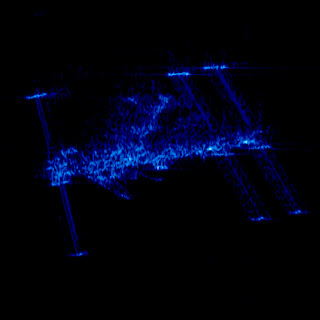
Pretty Picture: ISS in the X-band - The Planetary Society Blog | The Planetary Society

This spooky-looking image is the international space station as taken by a radar satellite, the German TerraSAR-X.

I actually worked with these radar satellites, though they are now my natural enemies. The basic way they work is very clever, and with appropriate analysis, you can extract things like tiny movements of glaciers from the data.


Full post